The HMC American Gamelan
Bill Alves, director
with special guests
Jeff Gauthier, violin
Stephen Klein, euphonium
Rachel Rudich, shakuhachi
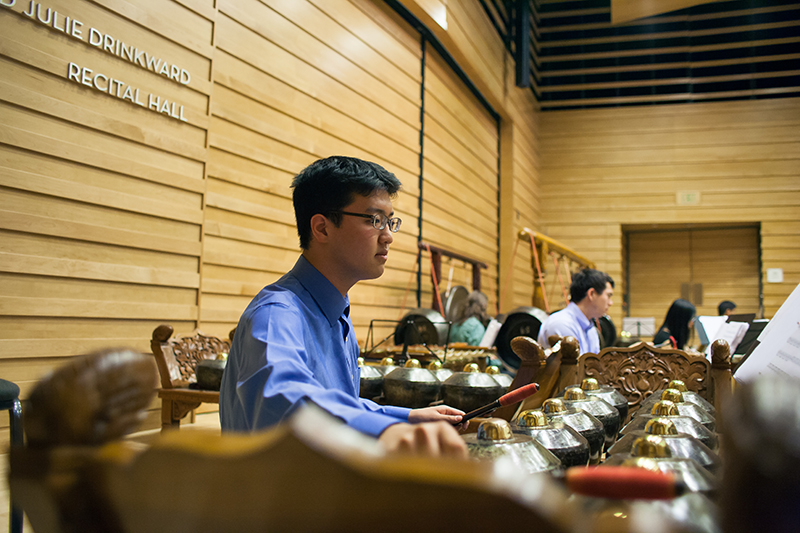
HMC’s ensemble of metallophones and gongs ring out in performances of works by Lou Harrison and Bill Alves.
Sunday, November 23, 7 p.m.
Drinkward Recital Hall
PROGRAM
Gending Demeter
Lou Harrison
(1917-2003)
(1917-2003)
Gending
Vogel Flats
Jeff Gauthier, violin
Bill Alves
(1960-)
(1960-)
Gending
Ibu Trish
Harrison
Rachel
Rudich, shakuhachi
Angel’s
Crest
Alves
Gus Gil, gendér panerus
Bill Alves, gendér barung
Kenneth Cotich, gongs
Bill Alves, gendér barung
Kenneth Cotich, gongs
Main
Bersama-Sama
Harrison
Rachel Rudich, shakuhachi
Stephen Klein, euphonium
Stephen Klein, euphonium
At First Light
Alves
Rachel Rudich, shakuhachi
Gending Demeter (1981): Lou Harrison was first entranced with the bell-like tones of the Javanese gamelan orchestra as a young man in the 1930s. Unwilling to wait until he had access to such instruments, Harrison and his partner Bill Colvig built their American Gamelan in the early 1970s. Finally, in the summer of 1974, he had the opportunity to study and play a traditional Javanese gamelan in Berkeley California, and soon after he met one of the great Javanese masters of this music, Ki K. P. H. Wasitodiningrat, familiarly known as Pak Cokro. It was Pak Cokro who first encouraged Harrison that he write for the Javanese gamelan, and Harrison soon began turning out a large body of works for the ensemble. As Harrison had always been an enthusiastic reader of Greek and Roman classics, he composed a series of works named for Greek gods, often reflecting those archetypes in the musical character of the pieces. Demeter was the Greek goddess of the fertility of the earth, and by honoring her, Harrison also symbolically reflected his own environmental concerns.
Gending Vogel Flats (2002). Vogel Flats is a beautiful area in the Angeles National Forest, and “gending” is a generic Indonesian word for gamelan piece. This particular marriage of Asian gamelan with European violin is cast in a non-traditional and rather mysterious mode of the Javanese pelog scale.
Gending Ibu Trish (1989). One of Lou Harrison’s devoted gamelan musicians was Trish Nielsen, who led Gamelan Kembar of San José, California. This piece dedicated to her was written for that ensemble, a “chamber” gamelan from West Java called a gamelan degung. It is known for its distinctive scale and its use of a bamboo flute, which plays bird-like elaborations on the main melody. Tonight’s version is an arrangement for the Central Javanese-style gamelan.
Angel's Crest (2007) is a piece in the slendro tuning system featuring the génder metallophone instruments. Unlike traditional gamelan music, it explores constantly shifting, expanding, and contracting cycles of time.
Main Bersama-sama (1978) is one of Lou Harrison's several marriages of the Indonesian gamelan with Western solo instruments, this one written for Scott Hartman, then at San Jose State University. The title means “playing together” in the Indonesian language, a reflection of Harrison's ideal of a cross-cultural musical community. This spirit is also reflected in the alternation between the Western euphonium and the Asian bamboo flute.
The music and video animation in At First Light (2012) were composed in tandem. The visual images were created in non-real-time with POV-Ray rendering software to correspond to changes in pitch sets and tonality in the electronic and gamelan sounds. The symmetrical patterns of the images often reflect the numerical patterns of the musical tuning systems you hear.
Lou Harrison (1917-2003) was one of the great American composers of the twentieth century and a pioneer in art of cultural hybrids and alternate tunings. As a young man in California he studied with Henry Cowell and Arnold Schoenberg and with his friend John Cage established the first concert series devoted to new music for percussion. In 1943, Harrison moved to New York, where he made a name for himself as a composer, critic, and conductor, premiering the Third Symphony of Charles Ives. However, to escape the stress and noise of the city, he moved back to California in 1953, where his relative isolation was the perfect environment to study his interests in Asian music and just intonation. In the 1960s he traveled to Asia, studying Korean and Chinese music. In the 1970s, he began studying and performing Javanese gamelan music and would produce a remarkable body of nearly 50 pieces for the orchestra, often in combinations with Western instruments. By the 1990s, the world began to catch up with Lou Harrison, who by the time of his death was recorded on dozens of CDs and was the subject of many festivals and tributes. In 2001 he was the guest of honor at the MicroFest conference here in Claremont.
Bill Alves studied the music of Java and Bali during a 1993-94 Fulbright fellowship and is now the director of the HMC American Gamelan. He is the co-author of Lou Harrison: American Musical Maverickand author of Music of the Peoples of the World is now in its third edition from Cengage/Schirmer. His recordings include The Terrain of Possibilities, Imbal-Imbalan, Mystic Canyon, and Guitars and Gamelan. His work with computer animation pioneer John Whitney inspired his abstract computer animations with music, now released by the Kinetica Video Library as Celestial Dance. He has extensively explored non-standard tunings in his work and is a co-director of MicroFest, the Southern California festival of microtonal music.
Rachel Rudichis a western flute player whose music can be explored on more than forty published CDs. Her forty-five-plus year career specializing in contemporary music opened her eyes to extended techniques, Japanese music, and eventually to the shakuhachi. Rudich performs often with her shakuhachi and koto duo, Hana Hibiki with koto player Kozue Matsumoto, and has recorded shakuhachi for TV and video games, as well as diverse genres such as horror movies and even country western bands. Some highlights have been recording sessions for the TV series Kobra Kai, and the video game League of Legends. In addition to shakuhachi, Rudich also enjoys playing suling. She has attended and performed internationally at the World Shakuhachi Festivals, as well as the Rockies Shakuhachi Camp in Boulder, Colorado. In 2018 Rudich also performed a solo concert in Tokyo of pieces for shakuhachi and electronics by American composers.
As an improvising violinist Jeff Gauthier has performed and recorded with Nels Cline, Alex Cline, Yusef Lateef, Adam Rudolph, Nicole Mitchell, Mark Dresser, Myra Melford, Vinny Golia, Todd Sickafoose, and many others. His own ensemble, The Jeff Gauthier Goatette has recorded six albums for Cryptogramophone Records. He currently performs, records and writes music for his improvising duo “The Smudges” with his wife, ‘cellist Maggie Parkins. In the world of classical music, Jeff performed regularly with the Los Angeles Music Center Opera, Los Angeles Master Chorale, Long Beach Symphony, Oregon Bach Festival, Carmel Bach Festival, and most recently with Bang on a Can All Stars for the celebration of Terry Riley's 90th birthday.
HMC is deeply grateful for the generous support that created The Ken Stevens ’61 Founding Class Concert Series.