The HMC American Gamelan and Guests
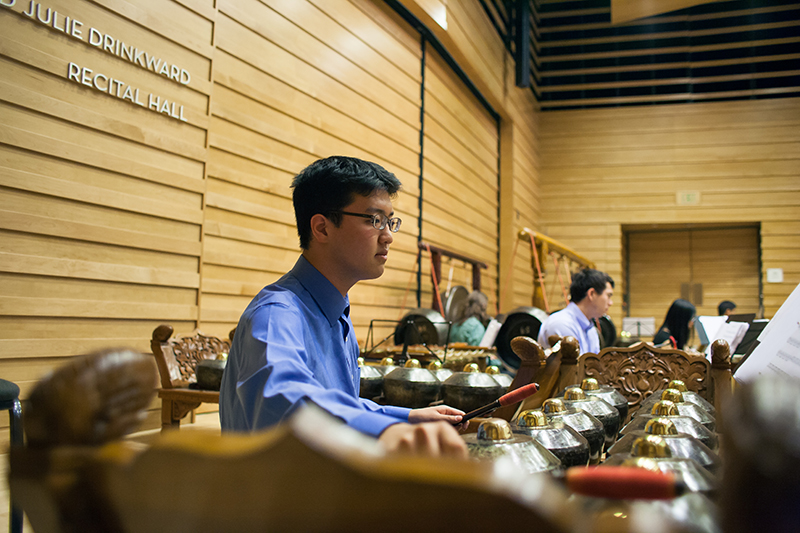
HMC’s ensemble of metallophones and gongs ring out in performances of works by Lou Harrison and Bill Alves.
The HMC American Gamelan: Alicia Byer, Joseph Conjusteau, Aracely Duarte Perez, Sebastian Heredia, Greg Jackson, Irene Jung, Jenny Soonjin Kim, Kevin Louis Ortega, Yoon Sun Pai, Karis Peebles, Nata Velarde-Alvarez, and Bill Alves, director
with special guests
Alicia Byer, clarinet
Cynthia Fogg, viola
Jeff Gauthier, violin
Sunday, November 22, 7 p.m.
Drinkward Recital Hall
PROGRAM
A Cornish Lancaran Lou Harrison
Alicia Byer, clarinet
Elegy in Memory of Bill Colvig Bill Alves
Jeff Gauthier, violin
Elegy, Waltz, and Polka Tom Flaherty
Liminal Landscape Alves
Threnody for Carlos Chávez Harrison
Cynthia Fogg, viola
A Cornish Lancaran (1986) In his gamelan compositions, Harrison often reflected the ideal meeting of cultures by including Western instruments in concerto-like forms. In 1981 he wrote Lancaran Samuel using an untraditional combination of pitches from the Javanese pelog tuning system to form his scale. A lancaran (pronounced “lancharan”) is a Javanese form with a very compressed gong cycle, that is, just 8 beats between each large gong stroke. In preparation for a concert at the Cornish School in Seattle in 1986, Harrison added a beguiling, blues-influenced melody within this unusual mode. He named the new piece for this school, where his good friend John Cage had performed Harrison’s works for (Western) percussion ensemble nearly 50 years before.
Elegy in Memory of Bill Colvig (2000) was written shortly after the death in 2000 of Colvig, who designed and built one of the first American Gamelans in 1970. He was a wonderful musician, instrument designer and builder, mountain climber, and collaborator with his life partner composer and microtonal pioneer Lou Harrison. Like many, I was charmed by Bill's energy, good humor, love of the earth, and his puns.
Elegy, Waltz, and Polka (2004). Elegy, the first of these pieces, is not intended to refer to a particular loss, but it was written in the aftermath of the 2004 Madrid train bombings and many subsequent politically motivated deaths. It seems that the daily news found its way into the piece, which, in the manner of an elegy, projects brooding resignation, dark futility, and grim determination, tempered by brighter, nostalgic moments. Upon completion it seemed to need a companion piece, though it was unclear what. When I jokingly asked my wife Cindy “What’s the opposite of an elegy?” she suggested, without missing a beat, “a polka?” The resulting last movement, possibly the first polka ever written for gamelan, seemed too jarring to immediately follow the Elegy, so there is a short Waltz to prepare us for the unbridled spirit of the Polka. Although the set makes an odd sort of sense to me, the movements may be played separately, possibly to their advantage. Elegy, Waltz, and Polka was written for Bill Alves and the members of the Harvey Mudd American Gamelan.
Liminal Landscape (2012). Liminal spaces are those transformative regions that exist between states of being, spaces that can be accessed through music and ritual. This work moves metaphorically through such spaces both sonically and visually. The instruments and electronics here move through the dual tuning systems of the Javanese gamelan, known as pelog and slendro, as the video, which was composed in tandem with the sounds, traverses regions of light and shadow.
Threnody for Carlos Chávez (1979). This work honors the famous Mexican composer with a heartfelt elegy. While traditional Javanese pieces are based on elaborate hierarchical metrical divisions of two, this piece borrows from medieval trinitarianism the idea of metrical divisions entirely based on three.
Lou Harrison (1917-2003) was one of the great American composers of the twentieth century and a pioneer in art of cultural hybrids and alternate tunings. As a young man in California he studied with Henry Cowell and Arnold Schoenberg and with his friend John Cage established the first concert series devoted to new music for percussion. In 1943, Harrison moved to New York, where he made a name for himself as a composer, critic, and conductor. However, to escape the stress and noise of the city, he moved back to California in 1953, where his relative isolation was the perfect environment to study his interests in Asian music and just intonation. In the 1960s he traveled to Asia, studying Korean and Chinese music. In the 1970s, he began studying and performing Javanese gamelan music and would produce a remarkable body of nearly 50 pieces for the orchestra, often in combinations with Western instruments. By the 1990s, the world began to catch up with Lou Harrison, who has been recorded on dozens of albums and was the subject of many festivals and tributes. In 2001 he was the guest of honor at the MicroFest conference here in Claremont.
Bill Alves studied the music of Java and Bali during a 1993-94 Fulbright fellowship and is now the director of the HMC American Gamelan. He is the co-author of Lou Harrison: American Musical Maverick and author of Music of the Peoples of the World is now in its third edition from Cengage/Schirmer. His recordings include The Terrain of Possibilities, Imbal-Imbalan, Mystic Canyon, and Guitars and Gamelan. His work with computer animation pioneer John Whitney inspired his abstract computer animations with music, now released by the Kinetica Video Library as Celestial Dance. He has extensively explored non-standard tunings in his work and co-directs MicroFest, the Southern California festival of microtonal music.
Tom Flaherty is a composer and cellist who makes music for humans and electronics. He is Professor of Music Emeritus at Pomona College. His composing has been supported by the National Endowment for the Arts, the National Endowment for the Humanities, American Music Center, the Pasadena Arts Council, the Massachusetts Council for the Arts and Humanities, the Delius Society, and Yaddo. His music has been performed by such ensembles as Brightwork newmusic, Eclipse Quartet, Mojave Trio, XTET and Ensemble GREEN in Los Angeles; Dinosaur Annex in Boston; Speculum Musicae in New York; Earplay and Volti in San Francisco. Published by American Composers Editions and G. Schirmer, Inc., his compositions have been recorded on the Albany, Bridge, Capstone, Klavier, Reference, Orchid Classic, and SEAMUS labels.
Alicia Byer is a composer and clarinetist based in Pasadena. She originally hails from Claremont and holds a bachelors degree in music composition from Mills College, where her teachers included Pauline Oliveros, Fred Frith, Meredith Monk, Cecil Taylor, Joelle Leandre and others. She is currently pursuing an MFA at SeaSky University, a fully imaginary institution, where she is studying experimental history and practice with Dean Rosenthal, Bill Alves, and Pamela Madsen. Specific interests include neuroaesthetics, Jewish mysticism, coyotes, and social fictions. She is available for commissions.
As an improvising violinist, Jeff Gauthier has performed and recorded with Nels Cline, Alex Cline, Yusef Lateef, Adam Rudolph, Nicole Mitchell, Mark Dresser, Myra Melford, Vinny Golia, Todd Sickafoose, and many others. His own ensemble, The Jeff Gauthier Goatette has recorded six albums for Cryptogramophone Records. He currently performs, records and writes music for his improvising duo “The Smudges” with his wife, cellist Maggie Parkins. In the world of classical music, Jeff performed regularly with the Los Angeles Music Center Opera, Los Angeles Master Chorale, Long Beach Symphony, Oregon Bach Festival, Carmel Bach Festival, and most recently with Bang on a Can All Stars for the celebration of Terry Riley's 90th birthday.
Cindy Fogg has performed on viola and violin with Emmanuel Music, Monadnock Festival, Pasadena Symphony, Ojai Festival, Monday Evening Concerts, and the Almont and Euphoria ensembles, and appeared as guest violist with the acclaimed Kronos and Alexander quartets. Ms. Fogg has recorded chamber music for Naxos, Bridge, Opus One, Cambria, Klavier, and Innova, as well as soundtracks for motion pictures and television. She has taught at Pomona College and Pasadena Conservatory of Music.
HMC is deeply grateful for the generous support that created The Ken Stevens ’61 Founding Class Concert Series.